The Unhatchable Egg. A tale of five broodies

This is a short and very sweet story from the Summer and it further illustrates just how wonderful Nature can be and so full of surprises. It also made me question that old adage. 'Don't count your chickens before they hatch'.

Mother and chick kissing

This dictum is said to have originated in the Aesopica, a collection of fables written by Aesop between  620 to 560 BC and in particular the moral tale of 'The Milkmaid and her Pail'. The illustration below is a woodcut by Helen Siegl from the artofchildrenspicturebooks blogspot.

don't count your chickens
In Aesop's fable the girl walks home with a bucket on her head planning in stages how she will convert the very saleable, rich milk in her pail to finery. She will buy eggs, hatch chicks, grow then on and purchase a party frock with the proceeds. Of course it all comes to naught because as she thinks about the gown and how she will disdainfully wow the local lads, she tosses her head and drops the milk. Then of course comes the sententious punch line. Personally I don't go in for morality tales, they smack to much of the status quo, I like them where the eggs hatch and they all live happily ever after. 


Like the following:

Broody hens - an introduction


Broody Ardenner hen wanting in to the chicken coopI've written of this on other occasions but I think it is apposite to include it here, that in my experience there is no such thing as a typical broody hen and furthermore that there are many reasons why a bird becomes and maintains the character of the broody.

These are:

Status - To a young hen, or one low in the pecking order, being broody gives status, which it may otherwise take her months or even years to attain.
Position - a broody hen and even more so, the mother of chicks, is revered by the whole flock, which as a collective has, in my experience a fine understanding of continuance.
Freedom - in a forest garden, likes ours where there are several flocks and thus territorial boundaries decided by the birds, a broody and/or hen with chicks has passe-partout.
Food - a broody has by her very nature of quasi-'insanity' priority at the food bowl, plus I usually allow my broodies and mother hens and chicks, first sitting at breakfast and they know this.
Respect - by the very nature of a broody's erratic and often aggressive behaviour, she can instil fear and or reverence into the heart of even the bravest of cockerels
Protection - broodiness and motherhood can often bring out monogamy in a cockerel, many of my broodies find themselves squired around the garden, this happens in particular if the male believes that the chicks are his own.
Respite - in a mixed flock, particularly with young males, hens can get chased and annoyed by over-amorous cockerels. Being broody keeps them out of harms way, in particular if the hen has also formed a relationship as in the previous paragraph.
Peace - there is a great deal to be said for spending hot Summer days, in a cool hen house chatting with your friends.

To this end it should become obvious that, not all broody hens incline to motherhood and that being a serial broody has its advantages.

Why I leave broodies alone


Victorian inn keeper and her brood of chicks
Even prior to the First World War there was a move afoot to industrialise farming and bring it into the Agrochemical domain. To this end many things had to change, from the side-lining and then near annihilation of ancient, slow growing, independent and ancient breeds to the breaking and breeding out of natural impulses such as broodiness. If you want a hen to be a laying machine in a factory farm then you certainly don't want her broody. This in turn engendered a whole new set of satellite industries, such as small-scale incubators, heat lamps, plastic feeders, chick crumbs and of course medication and vaccines. A complete paraphernalia of goods which previous generations of small homesteaders, including my innkeeping great grandmother, seen here above with her brood of chicks, could quite easily do without. 

Polish chicks

Of course with the reversal of this trend of the past decades and a return to organic farming, chicken keepers have began to realise that a good broody is a very rara avis indeed. Furthermore, just ask yourself what would you rather have if you were a chick, a warm loving feathery Mummy or a heat lamp and a pile of shavings?

Mother and chick free-ranging in a meadow
Even so it can be annoying to have several broodies blocking up the nest boxes and chasing away your laying hens. This is particularly annoying in a forest garden where your hens will quite naturally lay away and build up clutches of eggs and hatch them. To this end my solution is to give them an egg and put it in one nest box. Hens do know the difference between a golf ball and a real egg and even if they have no intention of becoming mothers, the attraction of a nice smooth egg to sit on is very tempting. Thus, in the Summer I ended up with five broodies in one box all sitting on one egg. However, as all five of them fitted into different categories above, once the initial excitement of having a potential chick to hatch was over, they settled down quite happily in the one box and completely ignored the egg. Hence the following film:


Anyway, whoever heard of a milkmaid owning her own pail of milk?

It you have enjoyed this blog and found it interesting then please think about subscribing, sharing it and/or commenting. Please also feel free to ask questions. 

All the very best,
Sue

RELATED POSTS

broody hen in full display


Understanding broodiness in hens and how this helps in raising quail... read more


Cochin broody adopts chicks

 
Broody adopts chicks in cold weather - the amazing kindness of birds... read more


©  Sue Cross 2016

Treating inflammation, infection and bumblefoot with cabbage poultices - organic chickens and quail

I first used a cabbage poultice some ten years ago on one of my serial broody hens, Lucky. She was always sitting with or without eggs and often with some results she probably didn't count on, see below! After one particularly long period of being broody in which she sat with, or rather partially wedged underneath, three other hens, I noticed she developed a limp. When she came off the nest she began to lift her one leg off the ground and hold it tightly in a ball, as if some involuntary nerve spasm was forcing this to happen. 

Organically raised hen and chicks

As I could find nothing obviously wrong with her foot or leg, I asked the advice of a friend of mine, an organic dairy farmer, who as part of her continuing education had spent several months shadowing an organic vet. She suggested Lucky might have a constriction in her leg caused by a swelling on her 'knee' and it was true she did have what seemed the very slightest evidence of scaly leg mite in this area. My friend Marie-Agnès suggested that I tried a cabbage poultice, traditionally used here in France for many conditions including inflammation due to sprains, strains and cancers. I put a poultice on Lucky over the following five nights it was so successful I have always kept part of the ingredients 'on ice' and ready just in case.

Injured quail cabbage poultice
Recently I had occasion to use this poultice again on two cases which turned up simultaneously, one of my quail, Drusilla injured her foot and my neighbour's hen had a case of suspected bumblefoot. As I already mentioned before, one of the ingredients I always have in stock in the freezer. This is organic pig's lard which I rendered down from trimmings given to me freely by our organic butcher. It might be an idea, if you have one near you to ask, as I do find this type of fat very suitable as a carrier for making any kind of poultice. I have, at a pinch also used coconut oil but it melts very quickly particularly on a hot foot, whereas the lard keeps its form for longer.


This poultice keeps very well in a cool place, so you can make enough for five treatments at a time. Just consider when preparing it that it is the cabbage that is the active ingredient so you need by volume more of it than the fat. 

Savoy cabbage poultice organic poultry  

Brassicas - Anti-inflammatory and Anti-microbial Properties


Cabbage contains several anti-inflammatory nutrients, including:
- anthocyanins (flavenoids which make the red/blue pigment in fruit and vegetables) these are obviously more prevalent in red cabbage,
- polyphenols (antioxidants) present in abundance in all kinds of cabbage and
- the amino acid L-glutamine.

Cabbage also contains:
- the glucosinolate, sinigrin, which has anti-microbial properties. The Savoy cabbage I use is the one with a higher proportion of sinigrin, which is also prevalent in the seeds of another brassica, black mustard and was used historically in medicine as a 'mustard plaster'. Sinigrin is now being looked at in relation to cancer prevention and treatment, in particular colon, bladder and prostate cancers. Research published in 2014 also highlighted the potential of sinigrin as an anti-cancer agent for liver cancer.


Above - my neighbour's hen with swelling to the metatarsal pad of her foot.

Timing


Cabbage poultice for bumblefoot
The best time to put a poultice on poultry is at night, cabbage poultices, particularly when made with a delicious organic fat can be very interesting to a bird, even one who has just dined. I like to put the poultice on and then put the patient to bed in a cardboard box in the dark. In the morning I get the poultice off early so the patient doesn't have time to investigate, start to unravel and/or eat the poultice. A cabbage poultice has the ability to withdraw toxins, so it's best not to let the bird get a chance of eating it. However, with the very professional vet bandage (above) we did make an exception as there was no way my neighbour's hen could break into it!

Ingredients and Materials


organic Savoy cabbage poultice
Several large leaves of organic cabbage, I like to use Savoy but I have used red cabbage too.
A walnut-sized piece of pig's lard
Organic cotton wool (25% of the World's pesticides are used in the production of cotton)
A bandage, or in my case remnant strips of organic fabric or old organic tee shirts!
 

Method


Making a cabbage poultice
Chop cabbage roughly and then dice using a stick blender or liquidiser.

Add fat and make it into a smooth green paste. You can obviously do this all by hand but you will need to chop the cabbage very finely to extract the maximum amount of juice to be carried by the fat.

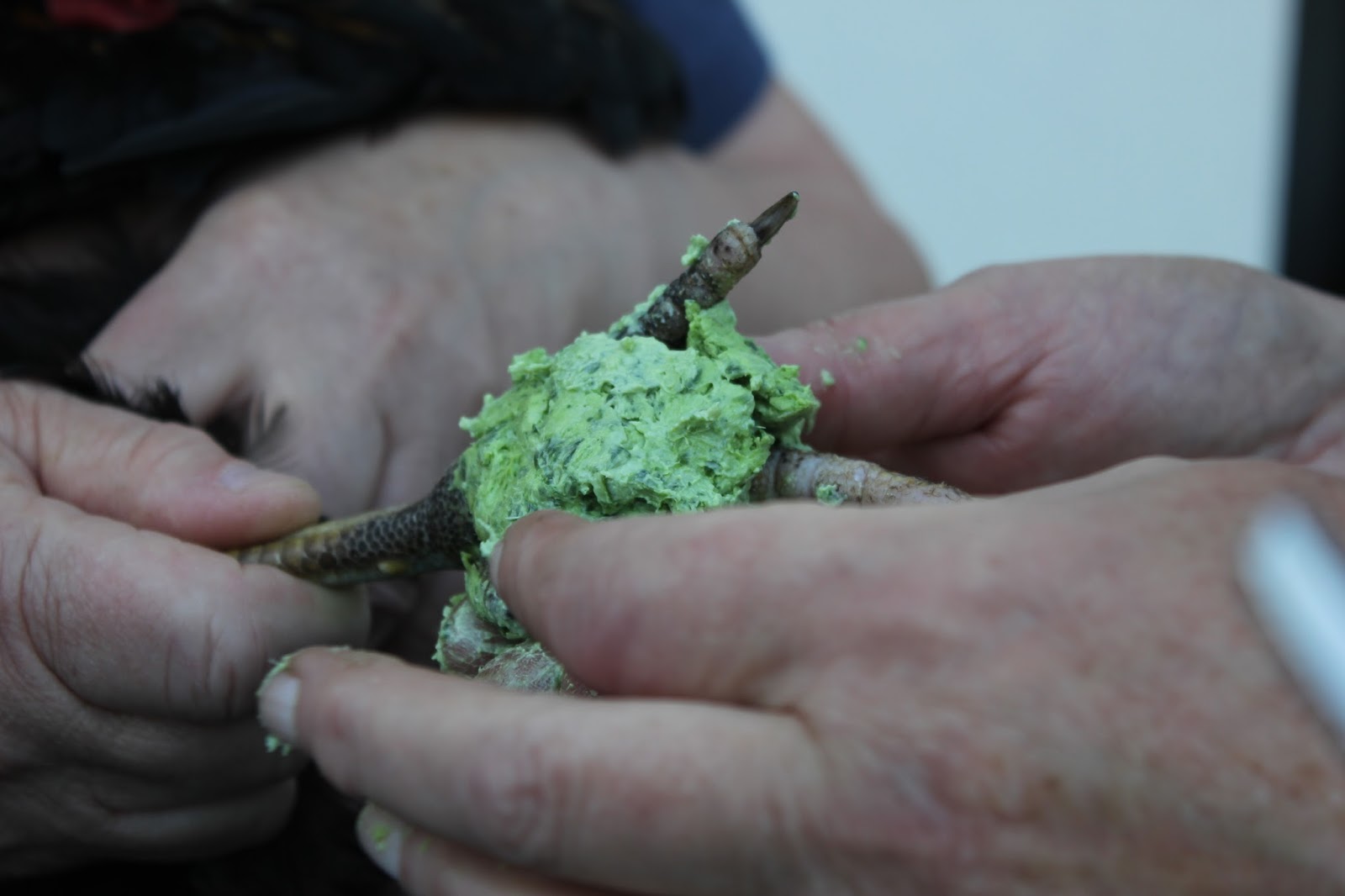
Using a cabbage poultice for bumblefoot
Liberally spread over affected area, I like to make it about 1cm (½") thick.

Cover with cotton wool, paying particular attention, when treating a foot as in this case (right) to the area between the claws, this helps to keep the whole preparation together whilst getting ready for the final bandage.

My neighbour works for the local vet so she had some very professional-looking additional stretch wrappings! 

using a professional stretch vet's bandage bumblefoot

Treating a chicken for bumblefoot with a cabbage poulticeAs I mentioned above, I put a fresh poultice on each night for five nights and this brought down the swelling on both Lucky and my quail. For my neighbour's hen, the swelling came down to reveal the tell-tale black 'scar' of bumblefoot, so we applied one drop of Tea Tree essential oil dissolved in one teaspoon of coconut oil evening and morning for five days, when the scar opened up and the hard pad of infection came out of its own accord. My neighbour then went on to disinfect the area further and bandage it up.

I further complemented the treatment for my injured quail with nutritional support and the article in which I discuss this can be accessed below via the 'read more' live link.

Treating a swollen foot with cabbage poultice
If you have enjoyed this piece and found it useful think about sharing it with your family and friends, on social media and also maybe about joining this blog and/or subscribing to my Youtube channel or even supporting us on Patreon or Please also feel free to ask questions. 

All the very best,
Sue


RELATED POSTS

Injured foot treatment for quail

Treating an injured quail Nutritional support for sprains, strains and nerve damage

Here's Drusilla she is one of my coturnix quail and over the past few days she has started to limp, holding up her foot and hopping...read more

Treating a nasty head wound and shock

Our poor quail, Nuggets with a horrible injury to her head and eyes (Happy ending!) ...read more

Quail chick with riboflavin deficiency - curled toe paralysisIdentification of riboflavin deficiency in purchased quail and hatching eggs

Quail have a high basal metabolic rate and as such their problems with nutrition are dramatically and rapidly revealed...read more

Quail chick being treated for riboflavin deficiencyCure curled toe paralysis (riboflavin deficiency)

For my 'field study', I am using the example of quail chicks, from non-organic purchased hatching eggs because this is the area in which, sadly I have a great deal of experience ..read more


RETURN TO CONTENTS PAGE  

©  Sue Cross 2016

Quail eggs, history, medicine and the pure pleasure of raising quail organically

We have a lot to be thankful for from our quail. It was the Spring of 2000 when we came to live here permanently in the wilds of coastal Western France and my greatest fear was that our then embryo forest garden, with its riot of flowering plants, trees and shrubs would make Summer unbearable for Andy. We already knew that privet (Ligustrum Ovalifolium) pollen was one of the key triggers for his hay fever and also the 'false' Acacia or Black Locust (Robinia pseudoacacia). Ironically, this latter, the flowers of which would make his eyes swell up even when he was entrenched inside the house, is an anti-spasmodic and in particularly used for inflammation of the eye!

Organic quail egg sushi
Japanese Coturnix quail eggs now we eat them for pleasure...a simple snack....

Organic quail eggs for breakfast


....a hearty breakfast...


....a substantial lunch or supper dish

Organically raise quail egg salad

Food and Medicine - Literature and Linguistics


The first ever quail I came across were in school and in the play Anthony and Cleopatra, I remember writing an essay on Shakespeare's clues to the doomed nature of the romance using as one of my supporting quotations:
'........; and his quails ever
Beat mine, inhooped, at odds.'
Proving that like chickens, quail were taken out of the wild, in this case by the Romans, to fight rather than for the culinary and/or medicinal value of their eggs or meat. Similarly, I remember seeing the quail appearing as a letter of the alphabet, if we can all it such, in Egyptian hieroglyphics. It's my conceit that the quail chick symbol should warrant a more comprehensive explanation than that of just a mere letter, over which, despite the Rosetta stone, there still seems much to debate.

Isis in the tomb of Seti I Valley of the Kings
Here the character/symbol of the quail chick, above left of the winged figure of Isis, is used in a mural in the tomb of Seti I in the Valley of the Kings. Although in the rubric depicted here, the quail chick may have a purely linguistic use, it is interesting that the image is that of the Osiris ritual. Isis, her wings outstretched preparing to seek the scattered body of her dead husband and in one version of the story, restore him back to life. In many cultures, Hindu, Russian, Chinese.., the quail was seen as a harbinger of Spring and thus also associated with a  symbolic return to life or reincarnation. The Bible also has an account of the saviour of the Israelites by consuming a flock of quail but with a proviso as laid out below.

It is interesting that the ancient Greeks certainly knew of the quail's seemingly magical ability to cheat death and survive on foods toxic to humans. Now referred to as coturnism or rhabdomyolysis (a form of acute renal injury), this is a condition suffered by hunters who eat migrating quail, the flesh of which can be toxic. The reasons for this is complex and as yet unsolved, in particular because only two of the three main migratory quail routes have 'poisonous' quail. To further complicate things, one route has them in Spring and the other in Autumn! Some researchers believe that it is the quail's consumption of  poisonous seeds, plants or insects, which make them toxic, others believe it is down to flight stress and/or a combination of these factors. There is also the hypothesis that the patient's own genetic make-up is involved and in particular a mutation which inhibits the sufferer from ridding his system of the ingested poison, making the condition akin to favism. I will put a link to an article at the end of Part Two that explores this interesting avenue into the ways of 'poisonous birds'.

My husband after organic quail egg treatment for hayfever
Similar to the fantail dove, the quail was also associated with love and romance, with a caged quail being given as a love token, the symbol of an imprisoned soul. So it was with much love and effort on everyone's part that we set about to return the Spring and Summer to Andy from several decades of misery and sneezing.

Quail Eggs and Meat as a Medicinal


It was in the very hot Summer of 1976 that Andy first started with hay fever and it was some time later that he started working with a mineral oil and developed eczema. Although we started out to deal with the former, the fact that we got rid of the latter too was an incredible bonus. It may seem to some that it was only in Victorian and Edwardian England and through the radio manifestations of Sherlock Holmes and Doctor Watson that people used to refer to 'pea soupers', or industrial heavy yellow smog. However, even when Andy was walking to school in the mid 60s, he had to wear a scarf about his mouth and around his throat to stop himself from choking on the toxic fumes. This was in the Industrial Midlands, at that time still the UK's centre of heavy industry and manufacturing. My guess is a combination of pollution and pollen had triggered this condition and our mission was to get rid of it. I'd read about quail eggs in the university library back in the UK and had started to look into ancient Japanese and Chinese medicine. I had read that in the 12th Century a Japanese Emperor with advanced TB had been cured by eating quail and knew that if I wanted organic quail I would have to raise them myself.

A home-made organic quail tractor
There wasn't a great deal of information to be found at this stage but I just went on the premiss that the more you allowed the bird to feed naturally the better. In these early days and within the confines of a predator safe area, I tried to let them have as much freedom as possible. Above is the quail tractor we devised to move around the garden. I bought my first quail from a traditional French country market, which has local small producers but I later found it better to visit people in their own home and see how the birds were raised. I must say it was not a pleasant experience, people seemed to have no compunction to fit the greatest amount of quail into the smallest possible cage. The only quail I ever found outside were in a small shed, on a concrete pad with one side open to the elements and covered with small gauge chicken wire. In the worst possible cases I came across, quail were crated in industrial wire cages stacked up on top of each other with artificial light and with the birds in such poor shape, their backs clawed by males and pecked by distressed and stressed-out females. At one home I found quail attacked and fatally injured within these cages, the owner obviously thought nothing of it. I actually felt so bad I bought some, hoping to get them back to health, needless to say they were too far gone. One thing that struck me was, that whatever the final outcome with regards to Andy's cure, just being able to see our quail coming out with a hop, skip and a jump into the open air and/or seeing them demolish a lettuce was a joy in itself. Once we had the greenhouses constructed and the possibility to use my neighbour's meadow for free-ranging afternoons, things were even better.

Free-ranging organic quailWe must have succeeded in our quest to raise quail to lay therapeutic-grade eggs, maybe it was the food, the lack of stress or a combination of both. For it only took a couple of dozen eggs, eaten lightly boiled and Andy was hay fever and eczema free and has been so since 2000. To show how new and interesting this all was back then, we were actually featured in a Japanese alternative living magazine. At the time I was told and had read, that it wasn't even certain what element in the quail egg was responsible. This for the some 34 cures of specific diseases and conditions, my friend the Japanese journalist identified when she researched around the piece she wrote on our quail. I am now aware that this was not the case but rather that a comprehensive body of research had dropped under the radar.

Organically raised quail chick Meet me in Part Two link below. 

Thanks for dropping by and do feel free to share experiences or ask for further information in the comment section. If you have enjoyed this piece and found it useful think about sharing it with your family and friends, on social media and also maybe about joining this blog and/or subscribing to my YoutubeOdysee  or BitChute Channel or even supporting us on Patreon or

It all helps to keep me going!


Until next time, all the very best from sunny Normandie! 

Sue


NEXT UP

Live Link to Part Two where I chronicle the fieldwork and  clinical trials of quail eggs in the 1960s, our own success with the treatment of eczema and hay fever, including how and how many and my changing quail set-up to breed the 'wild' back into my quail. 

RETURN TO CONTENTS PAGE  
©  Sue Cross 2016


Organically raised quail, obtaining therapeutic grade eggs to treat allergy and illness

In the first part of this piece I traced the domestication and symbolism of the quail back to ancient history and also looked at my own first attempts to raise them organically. If you have just landed on this page and wish to go back to the start of the post then the link is here.

organically raised quail egg with rice and Parma ham

Ancient Egypt via 12th Century Japan destination 60's France


It is now well documented that it was in the 1960s, when a rather tentative but brave volte-face away from the chemical love affair of the World War era began. This happened amongst private individuals, at the 'coal-face', where therapy by quail eggs began to make great strides in what has become known as 'alternative' medicine. Dr J.C. Truffier, who in his article; Approche therapeutique de la maladie allergique par ingestion d'oeufs de caille, La Clinique, 1978, 22, 2-4, (link at the end of this post)  first gathered together a body of practical research, which had been carried out in the field by several individual French breeders of coturnix quail. One of them, Mr. R. Cordonnier, had progressively rid his wife of asthma, and chronic multiple allergies, including dust, feathers and  dog hair, furthermore after curing her he had then gone on successfully to treat one of his employees. Another breeder, a Mr.  R. Albert, had treated many of his friends also successfully for asthma and it was noted, despite the time-frame  and  degree of severity of the individual condition. Dr. Truffier continues in the article to document his own and subsequent peer research.

Golden organically raise coturnix quail nesting

It was on the strength of these 'lay' results, witnessed in 1967 by Dr Truffier, that he commenced his own clinical trials of quail eggs, the following year. He chose a panel of clinicians and an initial group of 800 patients suffering from a variety of conditions. For what he refers to as 'moral reasons', these latter were chosen from those with no option for treatment on the conventional routes. The conditions included; hay fever, rhinitis, spasmodic or convulsive cough, allergic conjunctivitis, prurigo nodularis, eczema, psoriasis, peptic ulcers and scalp allergies (these were treated with 'quail egg shampoo'). Later into the trials a further selection of patients were treated to include conditions, which were treatable under allopathy, such as asthma, certain squelae or chronic complication of hepatitis, migraine due to allergy and malnutrition.

Not all quail are created equal


Charles Jobey frontispiece from La Chasse et la TableIn his book of  verse and prose 'La Chasse et la Table' published in Paris in 1864, Charles Jobey  wrote that the quail belonged to the highest aristocracy of the feathered world:-

 '...elle a les plus beaux quartiers de noblesse parmi les gallinacés. La caille a de droit ses entrées dans tous les hôtels du faubourg Saint-Germain; elle daigne honorer de sa présence ceux des Champs- Elysées ou de la Chaussée d'Antin.

However as Prosper Montagné, the French chef and author, born one year after this book was published,  pointed out in his own culinary work,  Larousse Gastronomique published  in 1930:

' ..and this is true in so far as the wild quail is concerned but applies much less in the case of the quail bred for food.' 

free-ranging organically raised quailAlthough the Ancient Egyptians had prized both the medicinal and culinary virtues of the quail and both eggs and meat had been included for centuries in the medical vademecum of the Japanese and Chinese, the birds they had written of, were wild. It was certainly the case by the 1960s that decades of industrial agriculture had completely changed the quail's diet, their levels of stress and  health. I was interested to note that Dr Truffier specifically mentioned in his article that the quail eggs he had used had come from a breeder whose quail were a mix of the wild and domesticated quail. In the 1960's these former could still be found in abundance in the Normandie countryside. In fact I'm happy to say our local organic dairy farm has them on its lands, even though my hunting neighbours swear they haven't seen them for decades and I'm keeping very quiet on the subject.

Posology


Many people prefer to take quail eggs raw and thus get the benefit of the maximum amount of active ingredient within the white of the egg, i.e. what in 1960 was identified as the human trypsin inhibitor (ovomucoid). From what I have read however, there is no huge loss, ovomucoid is not significantly denatured, if the egg is only soft boiled for a short time and also if the egg is not newly-laid. Other  ovoinhibitors and glycoproteins were identified in later studies but these too do not seem to be at risk from 'soft-boiling'. Andy didn't fancy eating raw egg, not because he thought it would be dangerous in any way but just because he didn't want to. In the end if the eggs had not worked for him as quickly as they did he would have consumed them raw.

organically raised quail eggs
In Dr Truffier's experiments, he used raw eggs and for his original patients, with conditions such as hay fever etc., followed a protocol similar to the one we used by default. This consists of; six eggs per day for nine days, a lay off of nine days, then nine days more and if necessary nine days lay off and six more days of eggs. For his later patients, those with asthma, etc., he started them gradually with four eggs a day for the first three days, five eggs for the following three and six eggs for the final three days. In our case Andy just took the eggs for a week or so in total as we only had a few of our own young quail laying and we just ate all the eggs available. Thus consuming approximately eight eggs per day. In effect this initial treatment of eggs was enough to rid Andy of his allergies. Our present quail have a natural cycle of laying a clutch of around eighteen to twenty eggs and then they stop. In recent years due I believe to a change in environment, i.e. a more permanently set up greenhouse area, they have begun also to make defined nests and go broody.

Organically raised quail egg salad
The eggs Dr Truffier gave to his patients were given on an empty stomach first thing in the morning, as a medicine, ours were eaten on an empty stomach but as our lunch. At that time, we were eating a small breakfast but for some years now we have changed to a full English breakfast eaten later in the day. If we were to do this now, then I would probably consider eating them first thing on waking as a preprandial snack.

Even though, I haven't been able to keep quail every year since 2000, due to the ravages of attacks from rats, from a nearby small broiler operation, now dismantled, Andy has never again suffered from hay fever nor eczema. The sceptics amongst you could imagine that the change of air to the seaside, the calm of rural France and our return to the land away from full-time and stressful employment, could have had something to do with his condition. We, however have always found that stress is something that tends to break out in the holidays and believed that we were actually doing something very stressful in coming here. We had both given up our careers and a steady  income, sold a property, moved house and from Andy's point of view were now living in a country where he couldn't speak more than  a few words of the language. To top it all, the garden and the farm lane outside the front door were both partly hedged with privet!

What happens next? 


With ever increasing allergy problems and respiratory conditions caused by pollution and food products, quail eggs have finally made it to the biotech industry and there are already products on the market containing dried organic quail egg. The paucity of information on the internet from seemingly an honourable mention in Ancient Egypt and Greece and a rumour from somewhere around 12th century Japan, has been much amended and added to over the last decade. According to recent uploads, apparently since Dr Truffier's first experiments, a new discovery on the virtues both nutritive and curative of the quail egg has appeared every few years since 1968.

Illustration of game from Mrs Beeton's Book of Household Management


I will make an analogy with the hare, beloved of the Victorians for a roast dinner but never successfully raised by them or since in caged captivity. Despite this defeat, the hare was certainly partially replicated in the 19th century in the form of the Belgian Hare, an amiable beautiful creature but still in reality, a rabbit. Mrs Beeton, the doyenne of English cookery and who wrote the ultimate and iconic Book of Household Management, at the age of 21 in 1859, has often been pilloried for her labour intensive food preparation. To this day, in an era of microwaves and ready-meals, people will quote the erroneous 'first catch your hare...' as an example of how foolish it all is. I would conversely suggest that this misquotation goes to the heart and true nature of good food and cookery and ultimately good health and medicine. Preparing and raising quality food isn't easy but it is a great deal more challenging and satisfying than opening a packet.

organically raised golden quail chicks hatching


In conclusion I would say the quail egg is a nutritional powerhouse even just judging by the chick which emerges but unless you are very, very lucky to find an organically raised one and furthermore if you want to do as we did and stop sneezing and/or scratching, then first, hatch your quail.

Bantam and quail chick
Thanks for dropping by and do feel free to share experiences or ask for further information in the comment section. If you have enjoyed this piece and found it useful think about sharing it with your family and friends, on social media and also maybe about joining this blog and/or subscribing to my YoutubeOdysee  or BitChute Channel or even supporting us on Patreon or

It all helps to keep me going!


Until next time, all the very best from sunny Normandie! 

Sue


RETURN TO CONTENTS PAGE 
©  Sue Cross 2016

LINKS PDF of Dr Truffier's Research (in French)  Poisonous Birds Prove that Nature Wants You Dead